Posted on 10/16/2026
Auto Repair Shop With Warranty Near Me: How Much More It Can Cost Than Having a Professional Auto Repair Shop Do the Work Right the First Time in Clackamas, OR There's a moment every vehicle owner in Clackamas knows well. The dashboard light flickers on, or a strange noise creeps in somewhere behind the engine, and the first instinct is to reach for the phone and search "auto repair shop with warranty near me." It feels responsible. It feels smart. A warranty sounds like protection, like a safety net that guarantees the work is covered no matter what. But here's what most people never stop to ask: what is that warranty actually protecting? And more importantly, what happens when the repair itself was never done right in the first place? This is the conversation almost nobody has honestly with vehicle owners. Not because the truth is complicated, but because the truth requires someone to care more about your long-term outcome than your short-term decision. And that ... read more
Posted on 10/12/2026
When Your Car Pulls, Drifts, or Destroys Tires — Your Alignment Is Trying to Tell You Something There is a language your vehicle uses on every road you drive, and most drivers in the Portland metro area never fully learn to hear it. It comes through in the way your steering wheel sits a few degrees off-center when your tires are pointed perfectly straight on a flat stretch of road. It shows up in the uneven tread across your front tires — feathered and worn on one shoulder while the opposite edge still carries usable life. It announces itself in the persistent, low-grade drift toward one side of the lane when you ease your grip on the wheel commuting on I-205 between Clackamas and Portland, or heading south on Highway 213 through the Oregon City corridor. None of those signals are random. None of them are simply what vehicles do with age and accumulated miles. Every one of them is your alignment communicating something specific and actionable — and every mile you co ... read more
Posted on 10/9/2026
You Wouldn't Eat at the Empty Restaurant. So Why Trust Your Car to the Empty Shop? Anyone who has spent a Friday night on SE Division Street in Portland knows the scene. The rain has eased to a light mist, the sidewalks are full, and the most popular restaurants have people waiting outside under their umbrellas, names on the list, happy to stand there for forty-five minutes. A few doors down, another place has its lights on, its tables set, and nobody inside. Most people choose the line. They don't need to think about it. A crowd outside in the rain is about the strongest review a restaurant can get. It means people tried it, came back, and brought their friends. Now picture that same person on a Tuesday morning. They're heading down the hill on SE Sunnyside Road toward I-205, it's raining steadily, and the brake pedal suddenly feels soft and low. By the time they reach the light at 122nd, they're calling shops. One says they can see the car Thursday. Another say ... read more
Posted on 10/5/2026
The 5 Biggest Concerns Drivers Have When Their Car Needs Repair in Clackamas, OR When something goes wrong with your vehicle, the mechanical problem is often only the beginning. Maybe your check engine light suddenly comes on while driving through Clackamas. Maybe you hear a grinding noise on your way to work. Maybe your vehicle begins shaking while traveling toward Oregon City or Happy Valley. Maybe the temperature gauge starts climbing while you are sitting in traffic. Maybe you notice a new fluid spot underneath your vehicle, an unfamiliar smell, or a vibration that was not there yesterday. Or maybe you walk outside one morning, turn the key or press the start button, and nothing happens. Almost immediately, your mind starts asking questions. How serious is this? Is my vehicle safe to drive? Could I end up stranded somewhere? How long am I going to be without my car? Can I trust what the repair shop tells me? Do I really need everything they are recommending? How is t ... read more
Posted on 10/2/2026
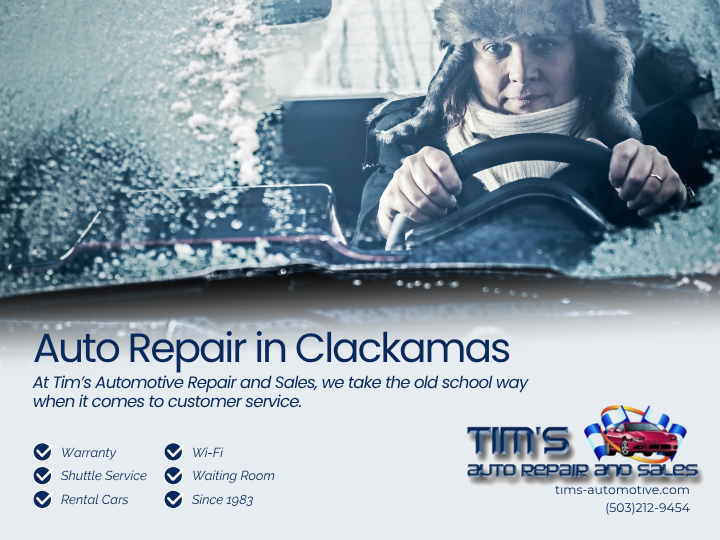
How Do I Get My Car Ready for Winter in Clackamas, OR? Winter preparation begins before the first icy windshield, slow engine start, or rainy commute that makes it difficult to see. It starts with understanding your vehicle’s condition and addressing the things that could interfere with safe, dependable transportation when the weather changes. For drivers in Clackamas, Oregon, winter readiness involves more than preparing for snow. Rain, early darkness, cold mornings, and changing road conditions can affect everyday trips throughout the Portland metropolitan area. A vehicle that seems fine on a mild afternoon may reveal a weakness when you need it before sunrise. Whether you drive around Clackamas, commute through Happy Valley, visit family in Oregon City, or travel toward Mount Hood, preparation should reflect where you actually go. The goal is straightforward: help your car start reliably, maintain traction, respond predictably, and give you a clear view of the road. That ... read more